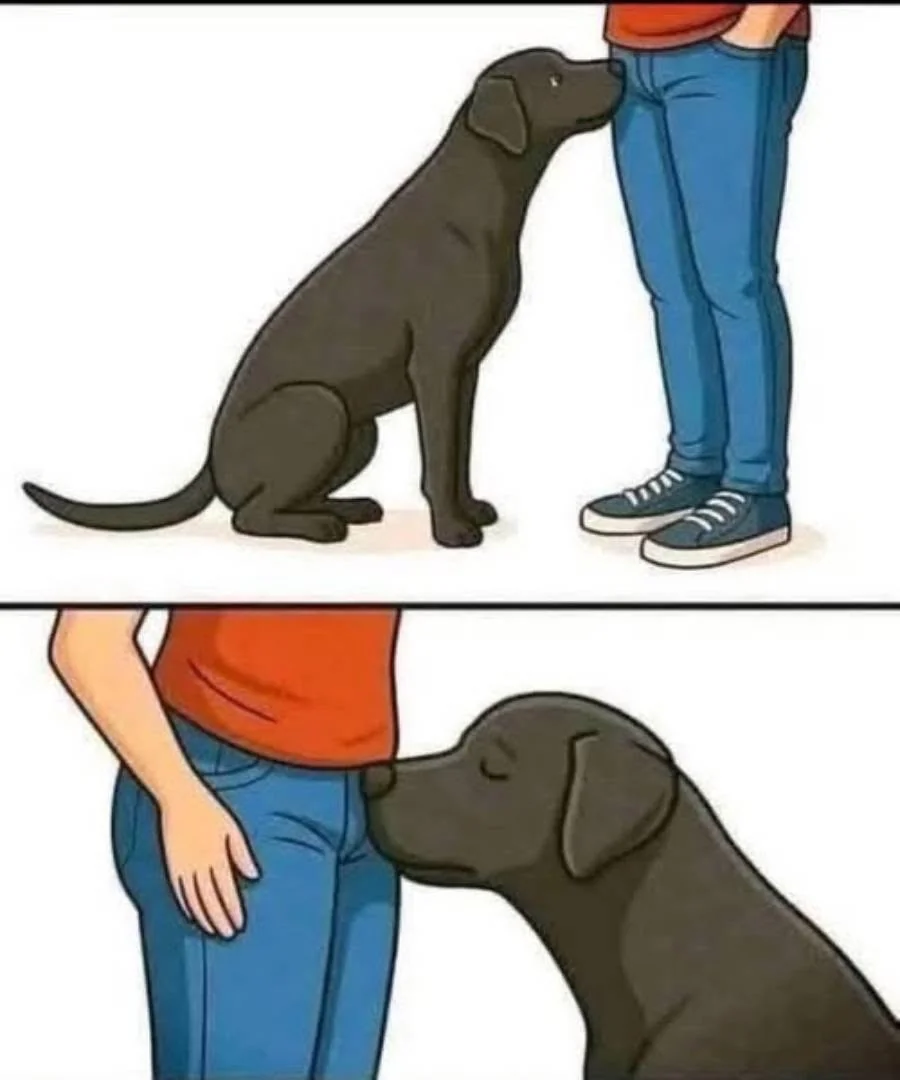
Have you ever noticed your dog sniffing your private parts and wondered why they seem so interested? While this behavior can feel awkward or embarrassing, it is completely normal for dogs. In fact, smelling is one of the primary ways dogs understand the world around them.
Your dog isn’t necessarily behaving inappropriately or trying to invade your privacy. They are using their extraordinary sense of smell to collect information about you and the environment.
In this article, we’ll explain why dogs smell private parts, what they can detect, whether pregnancy changes your scent, and how to respond when the behavior becomes uncomfortable.
Why Do Dogs Smell Your Private Parts?
Dogs explore the world primarily through their noses. While humans rely heavily on vision, dogs use scent to identify people, animals, objects, and changes in their surroundings.
Your genital and groin areas contain apocrine glands, which produce chemicals that contribute to your individual body scent. These odors can carry information that dogs find interesting.
When your dog sniffs your private parts, they may simply be investigating your unique scent.
1. Your Private Areas Have Stronger Scents
The groin and genital regions contain sweat glands and naturally occurring bacteria that contribute to body odor. These areas may produce stronger or more distinctive scents than your arms or hands.
Dogs have an exceptionally sensitive sense of smell, so odors that humans barely notice can be highly noticeable to them.
This is why a dog might focus on your groin area when greeting you, especially if you have recently exercised, showered, menstruated, or experienced hormonal changes.
2. Dogs Use Smell to Identify People
For dogs, smelling is similar to gathering information through conversation.
Your dog can recognize your familiar scent and may investigate changes in it. Sniffing helps them distinguish between individuals and learn more about what has happened in their environment.
Your dog may smell your private areas because the scent is concentrated there, not because the behavior has a sexual meaning.
3. Hormonal Changes Can Alter Your Scent
Hormonal fluctuations may change a person’s body odor. This can occur during:
- Pregnancy
- Menstruation
- Ovulation
- Postpartum recovery
- Menopause
- Certain medical or hormonal treatments
Dogs may notice some of these scent changes, although sniffing alone cannot prove that a dog recognizes pregnancy or knows that labor is approaching.
During pregnancy, changes in hormones, sweating, vaginal discharge, and body chemistry may make your scent different from what your dog is accustomed to.
Your dog may therefore show increased curiosity, but this does not mean they can reliably diagnose pregnancy or predict childbirth.
Why Does My Dog Smell Me More During Pregnancy?
Pregnancy can bring several changes to your body, including increased blood flow, sweating, vaginal discharge, and hormonal fluctuations. These changes may affect your natural scent.
Some pregnant people report that their dogs become more interested in sniffing them or behave differently around them. However, individual experiences vary, and there is limited scientific evidence showing that dogs can reliably detect pregnancy in a specific way.
Your dog might be reacting to:
- Changes in your natural body odor
- Increased sweating
- Changes in your routine
- New movements or behaviors
- Increased time spent at home
- Familiar scent changes associated with pregnancy
It is reasonable to think that your dog notices something different, but it would be inaccurate to conclude that your dog knows exactly what is happening inside your body.
Does This Mean My Dog Is Being Sexual?
No. Sniffing your private parts is not automatically a sexual behavior.
Dogs investigate scents without interpreting them in the same way humans do. A dog may sniff another dog’s rear, a person’s groin, clothing, or bedding because these areas contain useful scent information.
Even when dogs display mating-related behaviors, ordinary sniffing should not automatically be interpreted as sexual interest.
The most likely explanation is simple: your dog is curious and using its strongest sensory ability.
Why Do Dogs Smell Women’s Private Parts?
Dogs may show interest in anyone’s groin area, regardless of sex. However, hormonal changes, menstruation, pregnancy, and other variations in body scent can sometimes attract additional attention.
During menstruation, for example, the presence of blood and hormonal changes may produce odors that a dog can detect.
This does not mean dogs understand menstruation in a human sense. They are responding to scents and investigating something noticeable.
The same principle applies to pregnant women and people experiencing other hormonal changes.
Why Does My Dog Smell Me and Then Keep Following Me?
If your dog sniffs you and then follows you around, several explanations are possible.
Curiosity
Your dog may have detected an unfamiliar scent and want to investigate further.
Attachment
Dogs often follow people they feel connected to. Sniffing may happen alongside ordinary affectionate or attention-seeking behavior.
Routine Changes
If your schedule, mobility, or activities have changed, your dog may be responding to these differences rather than your scent alone.
Reinforcement
If sniffing consistently results in attention, talking, laughter, or interaction, your dog may repeat the behavior because it has become rewarding.
Following you after sniffing does not necessarily indicate that your dog knows you are pregnant or senses an upcoming event.
Is It Safe to Let Your Dog Sniff Your Private Parts?
Brief sniffing is generally a normal part of canine behavior. However, it is best to maintain appropriate hygiene and boundaries.
You should avoid allowing your dog to lick your genitals, particularly:
- During pregnancy
- After childbirth
- If you have stitches or a wound
- If you have an infection or irritation
- During postpartum recovery
After vaginal delivery, the genital area may be healing and more vulnerable to irritation or infection. Keep pets away from healing wounds and follow your healthcare professional’s hygiene instructions.
You do not need to punish your dog for sniffing. Instead, calmly redirect them when necessary.
How to Stop Your Dog From Smelling Your Private Parts
If the behavior makes you uncomfortable, you can teach your dog a different way to greet you.
1. Redirect Their Attention
Gently move away and invite your dog to sit or come toward your hand.
2. Reward Appropriate Behavior
Give praise or a treat when your dog approaches without sniffing your private area.
3. Teach a Greeting Cue
Training commands such as “sit,” “come,” or “leave it” can help your dog develop appropriate greeting habits.
4. Avoid Harsh Punishment
Sniffing is natural behavior. Punishment may confuse your dog or increase anxiety without teaching a useful alternative.
5. Manage Access
If necessary, use clothing, positioning, or physical distance to prevent unwanted contact.
Consistency is more effective than reacting angrily each time.
When Should You Be Concerned?
Occasional sniffing is normal. However, if your dog suddenly becomes excessively interested in your genital area, it may be worth considering whether there is a noticeable change in scent.
Possible causes include:
- Menstrual blood
- Increased sweating
- Urine leakage
- Vaginal discharge
- Skin irritation
- Infection-related odors
A dog’s interest cannot diagnose a medical condition. If you have unusual discharge, a strong unpleasant odor, itching, burning, pain, sores, or other symptoms, speak with a healthcare professional rather than relying on your dog’s behavior.
If your dog is persistently sniffing or licking one area of your body, redirect them and consider whether there has been a change that warrants medical attention.
Can Dogs Smell When Labor Is About to Begin?
This is a common question among pregnant women.
Dogs have highly sensitive noses, and they may notice changes in body odor during pregnancy. However, there is no reliable evidence that dogs can accurately predict when labor will begin.
A dog sniffing your private parts does not mean labor is imminent.
If you are near your due date, rely on recognized labor signs and your maternity team’s guidance, including:
- Regular contractions that become stronger and closer together
- Your waters breaking
- Vaginal bleeding that requires assessment
- Reduced fetal movement
- Other symptoms your maternity team has instructed you to report
Do not use your dog’s behavior as a medical indicator.
Why does my dog smell my private parts when I come home?
Your dog may be greeting you and investigating your scent. Changes in sweat, clothing, activity, or body odor can make the area particularly interesting.
Why does my dog smell my private parts more than other people’s?
Your dog may be familiar with your usual scent and notice changes in it. They may also have learned that you react or give them attention.
Does my dog know I’m pregnant?
Your dog may notice changes in your scent, behavior, routine, or physical appearance. However, there is no conclusive evidence that dogs reliably understand pregnancy or can predict delivery.
Should I be embarrassed?
No. This is normal canine behavior. You can calmly establish boundaries without feeling ashamed or treating your dog as if they have done something morally wrong.
Is it okay if my dog sniffs my underwear?
Dogs may be interested in underwear because it carries concentrated body scent. However, keep underwear away from your dog if they chew or swallow fabric, and prevent unwanted licking or contact with intimate areas.
Final Thoughts
When your dog smells your private parts, the explanation is usually much simpler than it seems. Dogs use their noses to investigate scents, recognize individuals, and understand changes in their environment.
Your groin area contains distinctive odors, and hormonal changes—including those associated with pregnancy and menstruation—may affect your scent.
The behavior is generally normal, but you are allowed to set boundaries. Calm redirection, positive training, and good hygiene can help you manage unwanted sniffing.
Your dog is most likely being a curious dog—not making a sexual statement or predicting your future.

